Not sure what this little guys is - maybe a hoverfly? He is kind of cute!
My favorites, abutilon, is starting to bloom as the days get shorter and the nights get cooler.
Don't remember planting this, but I am enjoying this pretty display of allums nerver-the-less!
We have never has squirrels here in SJC - until I bought this sweet little squirrel ornament. Suddenly I have started to see them here and there in the gardens! Weird!
There is quite a party going on here on the top stems of this Royal Queen Purple Violet Tubeflower (iochroma) that is not in bloom yet. Although it looks a little daunting at first, upon closer inspection, I'm pretty sure these rather unattractive little guests are actually ladybug larvae and quite welcome in my garden. I've made the mistake of over reacting before and getting rid of them before I took the time to realize that they are actually something that I want in my garden because they are one of the good bugs that do not eat plants, but do eat other bugs that do eat plants, mainly aphids. So now am thrilled to see all this craziness happening just as it should in a well balanced, natural, organic garden!

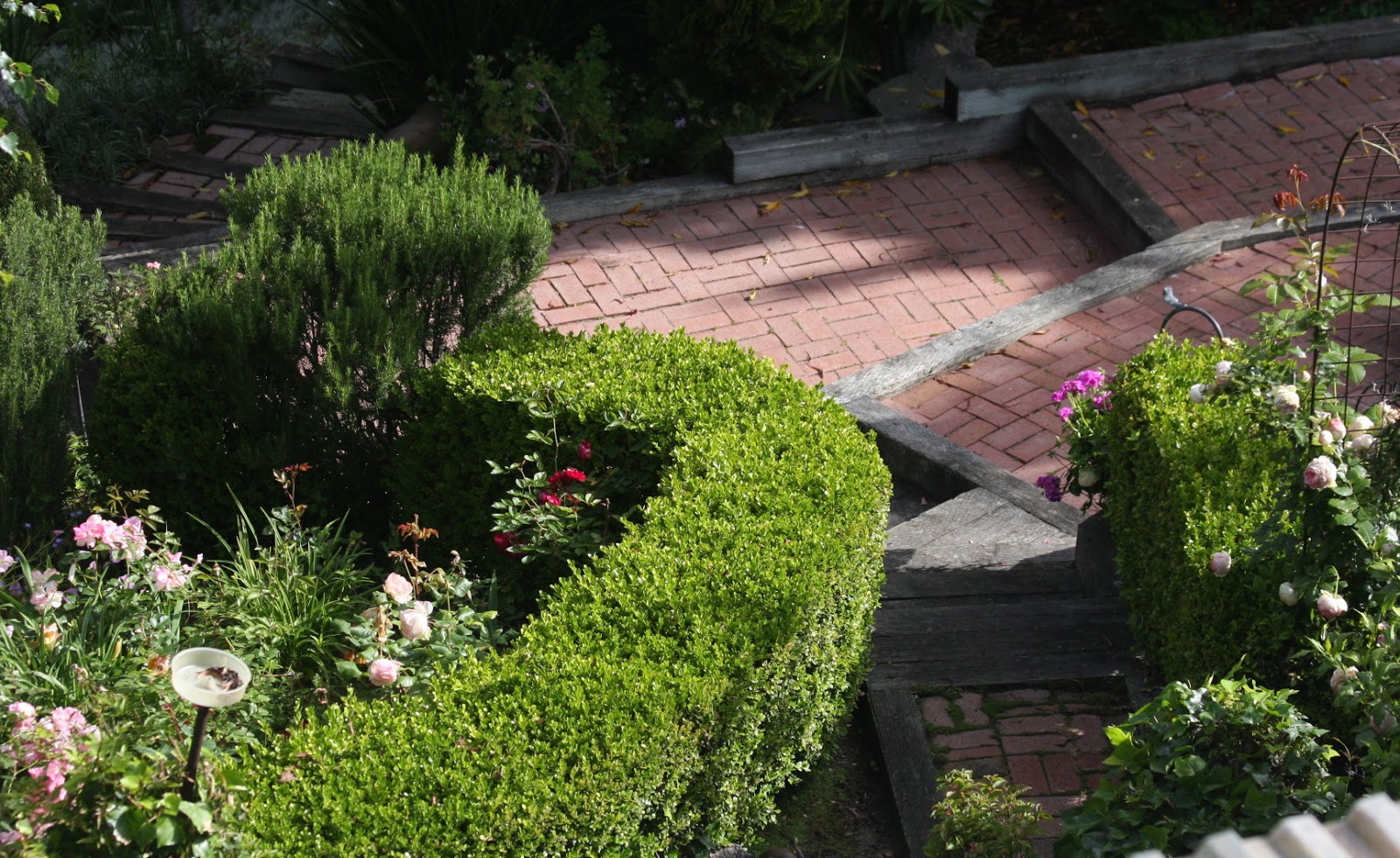
If you look closely at the bottom left hand corner of this view of the Laguna garden looking down from the deck, you will see a little plastic saucer on a tall pole sticking out. This is a left over relic from when I first changed my garden over to an all organic garden about fifteen years ago. I was frustrated with how horrible my garden looked from all the insect damage when I first went all organic. I used to laugh and tell people that you could tell it was an organic garden because it looked so bad. But I knew that this was not typical and that there were many people with lovely organic gardens, but somehow I was missing something. With research I learned that I needed to attract insect-eating birds to my garden, but I was not sure how. I went to a wild bird seed store and asked the clerk there and he sold me that contraption in the picture along with a container of live mealy worms to keep in my refrigerator. Every few days I would squeamishly add those horrible worms to that bird feeder and wait. Eventually it worked and after all these years I challenge anyone to find more than a few traces here and there of any insect damage. All the plants are fed with compost from the garden only and are strong and resilient. The garden is filled with life, bees, butterflies, birds and even bugs and insects as would any lovely garden. It took about three years after cutting out all pesticides and chemical fertilizers for the garden to stabilize and become what it is today - beautiful, thriving and naturally alive!
I am not sure what kind of native sage this is, I planted it years ago in a mixed bed outside the dining room window in SJC. It is kind of woody and blooms all year round with soft, hazy gray-green foliage. The unique thing about this plant is that it attracts a specific kind of bee. I don't know much about bees and I don't know what kind of bee it is, but at all times there is one, single, big fat black bee buzzing this plant. The bee moves from stem to stem, flower to flower, gathering pollen and then takes off. He returns in a few minutes to continue this quest. Now I am sure that it could possibly be more than one bee that loves this plant, but you only see one bee at a time, all the time. I never see that bee at any other plant, or in fact, anywhere else in the garden except on this sage. Truly a match made in heaven!
 This glad has to be at least ten years old. It just comes back year after year no matter what is going on around it, much to the delight of the local bee population.
 We harvested some garlic from the garden that was ready to be pulled up and be cured. I plant it in the fall around where the tomato plants are going because there is a rumor that it discourages hornworms. I don't know if this is true, but I never am bothered with the nasty buggers, so I'll continue the practice. Now if only I could find a deterrent for all the furry mammals that are eating the tomatoes before they even ripen!
 I have been feeling a little left out of the summer phenomenon of gardeners posting awesome pictures of bees on their blogs! I love reading about and seeing these amazing little creatures working away in their world of flowers and pollen. I have been really lazy about getting out in the garden with my macro lens to capture some pictures until the other day when I spotted this huge fellow, covered in pollen, scouring a sage plant outside the dining room window. He was kind enough to stay until I got a good picture. Now I am happy. But the birds... I need bird pictures!
 When I went out of town two weeks ago the 'Black and Blue' saliva and 'Stella de Oro' daylily blooms in this planter had yet to open. These were planted last year and the saliva was on my list to move to another, more open spot in the garden. That didn't happen. It does look lovely against the color of the house and picks up the colors in the stained glass windows, but as many plants do, when planted against a wall, this one gets devoured by insects as the summer wears on. I'm not sure I ever figured out what was doing all the damage, but it looked terrible by July last year and had to be cut to the ground leaving a bare planter. I think when plants are in a protected spot like this the birds and predator insects that keep most plants free of damage don't like to come so close to the structure and overlook the meal on the host plant. At least that's my suspicion. Also being in a small planter like this with little soil and no air circulation may add stress to the large plant, making it even more susceptible to insect damage. But so far this season it is beautiful and I will appreciate it while it lasts! It is a lovely saliva with striking colored foliage as well as dramatic dark blue flowers.
 Every time I am in the garden there is this one particular bee that is combing through the cerinthe plant. Of course I am not sure that it is the exact same bee, but it is the only place I ever see it and it is the only bee that looks like this that I ever see, so my guess it is the same one. He obviously loves this plant with a passion that is only seen in nature. I am not sure what kind of bee this is, we have lots of different kinds in the garden, but I always know where to find him!
 One of the most frustrating things I found when I first started to plant my garden was that so many of the gardening books and magazines I relied on for inspiration were based on the east coast and many of the plants that were used are not available in our area. One of those plants was Lady's Mantle (alchemilla mollis) and how I longed to find it because of its tall, lime green flowers that seemed to form a haze that set off other plants perfectly. I finally did find it at Dana Point Nursery and planted it in my Laguna garden where it lived for a few years. It does best in light shade and does require regular water so it needs to be placed where its cultural needs are met. But the thing that I think is most charming about this perennial is that the leaves hold little drops of water for hours and hours, making it a little watering hole for bugs and butterflies. I found it again this year at the Dana Point Nursery and put in a few in my garden by the front door in SJC where it gets a bit of pampering.
 I hear people talk about the disappearing bees all the time, but you wouldn't know there was a problem here!
 The Indian Hawthorne (Rhaphiolepis indica) is a bee mecca around here and is buzzing all day!
 With the holidays behind us (except for the Super Bowl, which is a holiday at our house) it is nice to get back to the garden and blogging. I have been very busy with company and travel and have gone nearly three weeks without so much as a walk around the garden. Although I didn't get out much last month, nature found a way to come inside and find me in the way of this charming praying mantis. It was on a cardboard box I was bringing in from the garage in which to ship ship presents. It is the first time I have ever seen one! Last year I read a novel and there was a reoccurring theme of praying mantis bringing luck. I can't remember the book, but I'm looking forward to the luck!
 While out photographing some of the bright yellow blooms of summer I caught this interesting bug on the blooms of the butterfly weed. I have no idea what he (or she) is, but I like his transparent wings!
 I had to smile when I saw these aphids on my butterfly weed. They are not the usual green or black ones, but bright yellow, just like the flowers. oddly enough they were gone the next day, undoubtedly a colorful dinner for some other bug!
 If I could banish one bug from my garden it would be the sawfly larvae. Sawflies themselves do not bother me, they eat mostly other bugs, but they lay their eggs on rose foliage and when they hatch they turn into little green worms that do more damage than imaginable. They live on the underside of the leaves and eat and eat and eat until the leaves are at least lacy and at the worse complete skeletons. A strong blast from the hose will dislodge them, as will hand picking, but you have to be diligent. Spraying with BT doesn't work because they aren't true caterpillars, besides, I have so many roses that spraying would be a big job. I have found that once roses are established and very healthy and strong, they will be bothered less, as are bushes that are out in the open as opposed to along a fence or wall. I have seen hummingbirds cleaning the backsides of roses in the garden, lapping up the little varmints I suspect. I am willing to live with some damage to my plants in exchange for an organic garden, but these ones really bug me!
 'Royal Sunset' Climbing Rose
 This is an unnamed hibiscus plant that I inherited with our house in SJC. It is blooming for the first time this season, and it begins with beautiful blooms that evolve into one of the biggest problem plants on the property. I threaten to take it out every year, but it remains. The problem is that it is in a corner planter that has walls on two sides and no automatic watering system. Hibiscus in our area are prone to whitefly infestation and this one is no exception. Because it is planted in a restricted area it doesn't get any air circulation and few visits from birds and beneficial insects. The only ones that seem to find it are those insects that feed on it and seek it out like the whiteflies (that lay their eggs on the undersides of the big leaves) and aphids. It is somewhat drought tolerant, but stresses out easily when it goes dry which attracts more insects. A strong stream of water will take care of the pests, but it has to be done consistently and that doesn't seem to happen. I guess the best solution would be to move it and replace it with a plant that is not so attractive to insects. Maybe I'll get around to that this year!
 Here is a picture of the new little citrus tree that we planted in the Moonlight Garden. It is a combination of four types of citrus all grafted onto one trunk. It has lemons, limes, oranges, and tangerines and I thought it would be kind of fun.
 Unfortunately it has been hit with the citrus leaf miner which is becoming a problem in our area because there are few natural enemies. The citrus leaf miner is a little moth that lays its eggs on the leaves of citrus trees and when they hatch the larvae mines into the leaf and causes distorted foliage. Although it is unsightly it is not fatal to the tree and it only attacks the new, tender foliage. The best course of action is to simply leave it be or remove the effected leaves. I have two other citrus trees and they are more mature and do not show any signs of this problem yet.
 The other day my son brought me outside to see this grasshopper that had been lallygagging on this rose blossom for the past two days near the driveway. He (or she) was quite alert and rose to attention when I focused in close with my camera, but still did not have the motivation to move. I checked again the following day and he (or she) was still there, enjoying the warmth of the sun in this prime location for viewing who is coming and going at the house. I don't know much about grasshoppers and what they do in the winter months. Although the days are still warm, the night have been getting chilly as so maybe he (or she) is getting ready to go into hibernation or whatever they do. If so, he (or she) could have picked a less obvious resting place since the bird feeder is nearby!
 One lovely morning last week while walking down the driveway in San Juan I spotted this lovely gulf fritillary (I formerly identified it as a monarch and I was incorrect) butterfly drying its wings after emerging from the cocoon attached to the underside of a felt plant. I have a bad habit of walking with my head down, staring at the ground. But if my eyes were looking up I surely would have missed this rare moment.



 This glad has to be at least ten years old. It just comes back year after year no matter what is going on around it, much to the delight of the local bee population.
 We harvested some garlic from the garden that was ready to be pulled up and be cured. I plant it in the fall around where the tomato plants are going because there is a rumor that it discourages hornworms. I don't know if this is true, but I never am bothered with the nasty buggers, so I'll continue the practice. Now if only I could find a deterrent for all the furry mammals that are eating the tomatoes before they even ripen!
 I have been feeling a little left out of the summer phenomenon of gardeners posting awesome pictures of bees on their blogs! I love reading about and seeing these amazing little creatures working away in their world of flowers and pollen. I have been really lazy about getting out in the garden with my macro lens to capture some pictures until the other day when I spotted this huge fellow, covered in pollen, scouring a sage plant outside the dining room window. He was kind enough to stay until I got a good picture. Now I am happy. But the birds... I need bird pictures!
 When I went out of town two weeks ago the 'Black and Blue' saliva and 'Stella de Oro' daylily blooms in this planter had yet to open. These were planted last year and the saliva was on my list to move to another, more open spot in the garden. That didn't happen. It does look lovely against the color of the house and picks up the colors in the stained glass windows, but as many plants do, when planted against a wall, this one gets devoured by insects as the summer wears on. I'm not sure I ever figured out what was doing all the damage, but it looked terrible by July last year and had to be cut to the ground leaving a bare planter. I think when plants are in a protected spot like this the birds and predator insects that keep most plants free of damage don't like to come so close to the structure and overlook the meal on the host plant. At least that's my suspicion. Also being in a small planter like this with little soil and no air circulation may add stress to the large plant, making it even more susceptible to insect damage. But so far this season it is beautiful and I will appreciate it while it lasts! It is a lovely saliva with striking colored foliage as well as dramatic dark blue flowers.
 Every time I am in the garden there is this one particular bee that is combing through the cerinthe plant. Of course I am not sure that it is the exact same bee, but it is the only place I ever see it and it is the only bee that looks like this that I ever see, so my guess it is the same one. He obviously loves this plant with a passion that is only seen in nature. I am not sure what kind of bee this is, we have lots of different kinds in the garden, but I always know where to find him!
 One of the most frustrating things I found when I first started to plant my garden was that so many of the gardening books and magazines I relied on for inspiration were based on the east coast and many of the plants that were used are not available in our area. One of those plants was Lady's Mantle (alchemilla mollis) and how I longed to find it because of its tall, lime green flowers that seemed to form a haze that set off other plants perfectly. I finally did find it at Dana Point Nursery and planted it in my Laguna garden where it lived for a few years. It does best in light shade and does require regular water so it needs to be placed where its cultural needs are met. But the thing that I think is most charming about this perennial is that the leaves hold little drops of water for hours and hours, making it a little watering hole for bugs and butterflies. I found it again this year at the Dana Point Nursery and put in a few in my garden by the front door in SJC where it gets a bit of pampering.
 I hear people talk about the disappearing bees all the time, but you wouldn't know there was a problem here!
 The Indian Hawthorne (Rhaphiolepis indica) is a bee mecca around here and is buzzing all day!
 With the holidays behind us (except for the Super Bowl, which is a holiday at our house) it is nice to get back to the garden and blogging. I have been very busy with company and travel and have gone nearly three weeks without so much as a walk around the garden. Although I didn't get out much last month, nature found a way to come inside and find me in the way of this charming praying mantis. It was on a cardboard box I was bringing in from the garage in which to ship ship presents. It is the first time I have ever seen one! Last year I read a novel and there was a reoccurring theme of praying mantis bringing luck. I can't remember the book, but I'm looking forward to the luck!
 While out photographing some of the bright yellow blooms of summer I caught this interesting bug on the blooms of the butterfly weed. I have no idea what he (or she) is, but I like his transparent wings!
 I had to smile when I saw these aphids on my butterfly weed. They are not the usual green or black ones, but bright yellow, just like the flowers. oddly enough they were gone the next day, undoubtedly a colorful dinner for some other bug!
 If I could banish one bug from my garden it would be the sawfly larvae. Sawflies themselves do not bother me, they eat mostly other bugs, but they lay their eggs on rose foliage and when they hatch they turn into little green worms that do more damage than imaginable. They live on the underside of the leaves and eat and eat and eat until the leaves are at least lacy and at the worse complete skeletons. A strong blast from the hose will dislodge them, as will hand picking, but you have to be diligent. Spraying with BT doesn't work because they aren't true caterpillars, besides, I have so many roses that spraying would be a big job. I have found that once roses are established and very healthy and strong, they will be bothered less, as are bushes that are out in the open as opposed to along a fence or wall. I have seen hummingbirds cleaning the backsides of roses in the garden, lapping up the little varmints I suspect. I am willing to live with some damage to my plants in exchange for an organic garden, but these ones really bug me!
 'Royal Sunset' Climbing Rose
 This is an unnamed hibiscus plant that I inherited with our house in SJC. It is blooming for the first time this season, and it begins with beautiful blooms that evolve into one of the biggest problem plants on the property. I threaten to take it out every year, but it remains. The problem is that it is in a corner planter that has walls on two sides and no automatic watering system. Hibiscus in our area are prone to whitefly infestation and this one is no exception. Because it is planted in a restricted area it doesn't get any air circulation and few visits from birds and beneficial insects. The only ones that seem to find it are those insects that feed on it and seek it out like the whiteflies (that lay their eggs on the undersides of the big leaves) and aphids. It is somewhat drought tolerant, but stresses out easily when it goes dry which attracts more insects. A strong stream of water will take care of the pests, but it has to be done consistently and that doesn't seem to happen. I guess the best solution would be to move it and replace it with a plant that is not so attractive to insects. Maybe I'll get around to that this year!
 Here is a picture of the new little citrus tree that we planted in the Moonlight Garden. It is a combination of four types of citrus all grafted onto one trunk. It has lemons, limes, oranges, and tangerines and I thought it would be kind of fun.
 Unfortunately it has been hit with the citrus leaf miner which is becoming a problem in our area because there are few natural enemies. The citrus leaf miner is a little moth that lays its eggs on the leaves of citrus trees and when they hatch the larvae mines into the leaf and causes distorted foliage. Although it is unsightly it is not fatal to the tree and it only attacks the new, tender foliage. The best course of action is to simply leave it be or remove the effected leaves. I have two other citrus trees and they are more mature and do not show any signs of this problem yet.
 The other day my son brought me outside to see this grasshopper that had been lallygagging on this rose blossom for the past two days near the driveway. He (or she) was quite alert and rose to attention when I focused in close with my camera, but still did not have the motivation to move. I checked again the following day and he (or she) was still there, enjoying the warmth of the sun in this prime location for viewing who is coming and going at the house. I don't know much about grasshoppers and what they do in the winter months. Although the days are still warm, the night have been getting chilly as so maybe he (or she) is getting ready to go into hibernation or whatever they do. If so, he (or she) could have picked a less obvious resting place since the bird feeder is nearby!
 One lovely morning last week while walking down the driveway in San Juan I spotted this lovely gulf fritillary (I formerly identified it as a monarch and I was incorrect) butterfly drying its wings after emerging from the cocoon attached to the underside of a felt plant. I have a bad habit of walking with my head down, staring at the ground. But if my eyes were looking up I surely would have missed this rare moment.

