
 In an earlier post (Mysterious Curves) I showed a curved walkway that inspired the viewer to continue on the path to see what was beyond the site line and some people requested to see what was actually beyond the curve... so here you go. This is the side garden near the front door of our San Juan Capistrano home.
 I try to resist the urge to scatter plaques
and other ornaments with witty sayings
throughout the gardens, but occasionally
I succumb, as in this case.
 This planter bowl is located on top of the waterfall filter in our front garden in Laguna. For years I planted it with annuals which I was forever having to replant, fertilize to keep looking lush, and prune and deadhead, all of which was very difficult due to the location of the pot. Finally I resorted to succulents and I have been happy with it ever since. There is a soft, peaceful hue to the colors and it is very low maintenance.
 One of the best plants for attracting butterflies to the garden is the passion vine (passiflora). It is the favorite food of the caterpillars of the gulf fritillary butterfly which is common to the southerner half of the United States. You must be willing to put up with some damage to the leaves while the caterpillars feast on them, but you will be rewarded with lots of lovely orange butterflies all summer. There are many different species and colors of this vine and some of them can get very aggressive if not kept in check. I had a red one that actually scared me it grew so fast. I was afraid if I walked through the tunnel it had made over some arbors I had that I may never come out again! I ended up taking it out to allow other plants in the area to live.This particular specie is 'Lavender Lady".
 I love a garden with mystery. One that invites the viewer to wonder in further to see what they might discover. One of the ways to create mystery in garden design is with curves, or more specifically, curved paths.My garden in Laguna was laid out around existing plants and trees and eventually developed into a series of interconnecting paths that crisscrossed the property. Unfortunately the gardens in San Juan are almost all straight lines with very little mystery. The picture above is one of the few walkways that you cannot see the entire layout ahead.
 This is a sweet little native columbine that is very delicate and simple. It lives in a planter under some palm trees along the driveway in San Juan Capistrano.One of the things about planting native plants here in California is that there are such diversity in the topography in our area that there are many, many different classifications of native plants.In other words, just because it is a native doesn't necessarily mean it will thrive in your yard. In fact many of the natives are very difficult to get established and almost impossible to propagate. One of the reasons is that there can be four or five different terrains in an area just a few miles wide.In Laguna Beach there are native plants that only live on north facing hills which typically have heavy clay soil and some plants that are native only to the south facing hills that have more sandstone in their foundations.Most of our California natives bloom in the winter which is our rainy season and go dormant in the summer. We often go seven or eight months at a time with no rainfall. The average rainfall for our area is 13 inches a year. But what that really boils down to is that some years we get four inches and other years we get 26 inches. You can imagine how tough the native plants must be to survive, let alone thrive!
 Some rabbits are welcome in the garden.
This is one of them. He doesn't eat much.
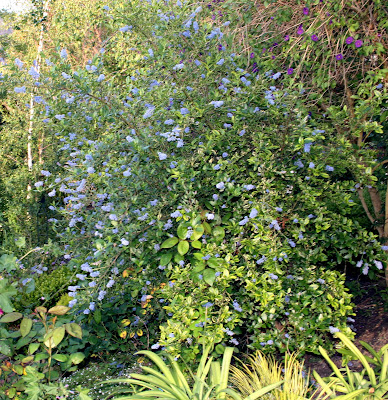
 Ceanothus are some of my favorite plants because I love blue flowers in the garden. They are native to California hillsides (thus require excellent drainage) and sometimes called California Lilacs or Wild Lilacs, which is rather misleading because they have no smell.There are many different varieties from groundcovers to huge bushes. I had one in Laguna that was at least 12 feet high until the voles ate the roots and it died overnight. My heart was broken when I discovered it so very, very dead. I have since replaced it with the smaller one in the bottom picture and it is blooming cheerfully, as if to be consoling while waiting to grow.Ceanothus varieties with very small leaves are said to be deer resistant, although we all know deer will eat anything when they are hungry enough! These plants are very drought tolerant, although the ground cover type do better with some water in the summer.
 My garden in Laguna is very loose and flowery and lends itself to whimsy quite naturally. It reflects the beach cottage house and its casual style.My home in San Juan Capistrano reflects the California Spanish heritage and the landscape is very stately and majestic with over a hundred very tall palm trees on the property. It does not do whimsy well at all.When we moved into this home last year for some odd reason I ordered this sheep from a garden catalog and when it came I regretted it because it just never "fit" the garden. Never-the-less, I put her right outside the front door much to my dogs' distress (it took them a while to quit barking at her every time they spotted her).Lately the poor thing has taken to laying on her side. I kind of suspect that a child tried to ride her because she is just that size, and has bent her hind leg. She gets uprighted a number of times a week, but just ends up on her side again.Maybe she is just tired.

 I love hydrangeas. Except if you cut the flowers you won't get anymore for the season. And for the dormant thing in the winter when they lose all their leaves and look like sticks that died along time ago. And because they produce their buds on old wood, if you even go near those naked sticks with pruners you will be punished with no blooms the following summer.But now there are the new hybrids called aptly "Endless Summer" and they have the ability to produce flowers on new wood as well as old wood. It sounded too good to be true and I suspected that there was some catch, but I planted a couple bushes last spring and I had blooms all summer AND more and more came even when I cut them to bring inside for arrangements.They only come in pink/blue and white mopheads so far, but that will suit me just fine.


